
How to Build Concert Stage Lighting for Large Venues
Building concert stage lighting for large venues requires more than installing powerful fixtures above a stage. In arenas, stadium halls, convention venues, theaters, and outdoor festival grounds, lighting systems must cover larger visual fields, support longer throw distances, adapt to multiple audience angles, and maintain consistent performance under demanding production schedules. A large venue concert lighting system must combine engineering precision, scalable fixture architecture, and visual storytelling logic.
For professional buyers such as venue developers, touring production teams, concert contractors, and stage system integrators, large venue lighting design is one of the most critical investment areas in live event infrastructure. A poorly designed system can create dark zones, uneven beam spread, weak performer visibility, and programming inefficiency. By contrast, a properly built large-venue lighting system improves stage impact, audience immersion, camera broadcast quality, and long-term production flexibility.
This guide explains how to build concert stage lighting for large venues, including fixture selection logic, truss architecture, zoning principles, control structure, and what professional buyers should evaluate before approving a scalable concert lighting solution.
Why Large Venues Need Different Concert Lighting Strategies
Large venues create lighting challenges that smaller theaters and clubs do not face.
As venue size increases, fixture throw distance becomes more important, beam consistency weakens over long projection paths, and lighting angles must compensate for wider seating geometry. Large venues also require greater visual balance between front-stage illumination, mid-stage dynamics, rear-stage depth, and audience interaction zones.
- longer throw distances require stronger beam precision
- wider seating layouts require broader coverage angles
- larger stages require multi-zone lighting control
- high ceilings require careful truss placement design
That is why major productions usually begin by mapping a full concert lighting structure before selecting individual fixtures.
What Are the Core Layers of Large Venue Concert Stage Lighting?
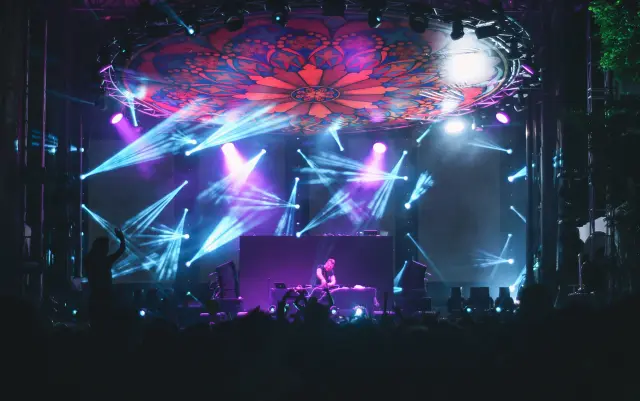
A professional large venue concert lighting system is typically built around layered fixture architecture.
- front wash layer for performer visibility and facial lighting
- mid beam layer for motion, aerial energy, and movement patterns
- rear depth layer for silhouette and stage dimension
- effect layer for strobes, impact moments, and transitions
- audience interaction layer for crowd sweeps and immersive engagement
Large productions often combine concert stage light beam fixtures with wash systems and strobes to create this full layered effect.
How Should Large Venue Stages Be Zoned?
Stage zoning is essential in large venues because one uniform lighting wash cannot serve all performance areas effectively.
Typical zoning includes:
- main center stage zone
- left and right performance wings
- rear scenic depth zone
- runway or catwalk extension zone
- audience sweep zone
Each zone should have dedicated fixture groups so lighting scenes can shift dynamically with performance movement.
| Zone | Main Lighting Priority | Purpose |
|---|---|---|
| Main Stage | high focus + wash | performer visibility |
| Side Wings | movement + fill | support performers |
| Rear Stage | depth lighting | stage layering |
| Audience Zone | sweep beams | immersion effects |
What Fixtures Work Best for Large Venues?
Large venues require fixtures with strong throw distance, stable beam integrity, and reliable movement precision.
- high-output beam moving heads for aerial effects
- wash moving heads for broad scenic coverage
- profile moving heads for key performer tracking
- strobes for rhythmic impact sequences
- laser systems for dramatic climax moments
Modern arena productions often rely heavily on concert strobe light systems combined with profile fixtures for high-definition live broadcast visuals.
How Should Truss Systems Be Designed?
Truss layout determines both safety and visual geometry in large venue lighting systems.
The most effective concert stage layouts usually include:
- front truss for wash and profile units
- mid truss for beam movement layer
- rear truss for silhouette and depth lighting
- side truss ladders for lateral angles
- floor support towers for dramatic low-angle beams
Proper concert truss light placement improves beam crossing symmetry and stage depth perception.
How Important Is DMX and Show Control in Large Venues?
As venue scale increases, control complexity rises exponentially.
Large venue systems often require multiple DMX universes, timecode synchronization, cue stack automation, and redundancy backup consoles. Fixtures must be grouped by function and zone rather than simple installation order.
- separate beam and wash universes where possible
- group by stage zones for faster scene programming
- allow backup override consoles for redundancy
- integrate timecode for repeated touring sequences
Without scalable DMX architecture, large venue rigs become inefficient and unstable under real performance pressure.
Common Mistakes When Building Large Venue Concert Lighting
- underestimating throw distance requirements
- too many beam fixtures without enough wash support
- improper truss height for beam spread
- ignoring audience zone lighting integration
- weak front-stage facial illumination
- overloading rig weight on limited truss spans
A common design mistake is creating visually strong aerial beams while leaving performers underlit for live broadcast and audience clarity.
Real Project Example: Arena Lighting Expansion Upgrade
In one indoor arena concert project, the original rig used sufficient beam fixtures but lacked front wash reinforcement. During rehearsals, aerial visuals looked dramatic, but singer facial lighting was inconsistent in wide-angle camera shots. After adding additional front truss wash hybrids and rebalancing truss heights, the system achieved stronger performer clarity without sacrificing stage spectacle.
What Should Professional Buyers Verify Before Approval?
Before approving a large venue concert lighting design, buyers should verify:
- whether throw distance calculations match venue size
- whether stage zoning is properly segmented
- whether truss loads meet engineering safety limits
- whether DMX universes match system complexity
- whether maintenance access remains practical during shows
Large Venue Concert Stage Lighting – FAQs
What is most important when building concert stage lighting for large venues?
The most important factor is balancing fixture power, throw distance, stage zoning, and truss structure into one scalable lighting architecture.
How many lighting layers should large venues use?
Most large venue concerts require at least five layers: front wash, beam movement, rear depth, effect layer, and audience interaction lighting.
What fixtures are essential for arena concert lighting?
Beam moving heads, wash hybrids, profile fixtures, strobes, and optional laser systems are essential in most arena-scale productions.
What should buyers review before purchasing large venue systems?
They should review throw distance suitability, rig safety, fixture scalability, control complexity, and long-term maintenance practicality.
In conclusion, building concert stage lighting for large venues requires strategic system architecture, not just powerful fixtures. The strongest large-venue systems combine layered design, scalable rigging, precision control, and venue-specific engineering.
For touring deployment and modular venue adaptation, refer to stage lighting setup.


Leave a Reply