
How to Sync DJ Lights with Music in Club Lighting Setup
Syncing DJ lights with music in club lighting setup is one of the most important parts of building a nightlife system that feels alive rather than mechanical. In modern clubs, bars, and entertainment venues, audiences expect lighting to respond to rhythm, drops, transitions, and energy changes in a way that enhances the music instead of distracting from it. When the system is programmed correctly, synchronized lighting makes the room feel immersive, premium, and professionally operated. When it is handled poorly, the venue may still have bright fixtures, but the performance feels disconnected and random.
For professional buyers such as venue owners, lighting contractors, integrators, and club operators, music-synced lighting is not simply a visual bonus. It affects customer experience, the perceived quality of the venue, the flexibility of the control system, and how effectively the nightclub can create different moods throughout the night. Many operators assume that syncing DJ lights with music is only about turning on a sound-activated mode. In reality, the strongest results usually come from a more structured system that combines fixture grouping, DMX programming, musical timing, and carefully planned effect logic.
This guide explains how to sync DJ lights with music in a real club lighting setup, what control strategies work best, how fixture types respond differently to music, and what professional buyers should consider when building music-responsive systems for commercial venues.
What Does It Mean to Sync DJ Lights with Music?
Syncing DJ lights with music means programming the lighting system so that movement, color changes, strobes, sweeps, and scene transitions follow musical structure rather than operating randomly.
In basic setups, this can mean fixtures reacting to beat detection or sound input. In more advanced nightclub systems, it usually means that lighting scenes are built around rhythm, BPM changes, musical drops, breakdowns, and overall set flow. The best music-sync systems do not necessarily flash on every beat. Instead, they create contrast, buildup, and release in a way that supports the energy of the room.
- low-energy music sections may use slow movement and wash-based color atmosphere
- build sections may increase fixture motion and brightness gradually
- drops may trigger fast beam sweeps, strobes, and accent effects
- breakdowns may reduce intensity to rebuild contrast
This kind of structured response is one reason professional dj lighting systems feel much more premium than simple automatic lighting modes.
What Equipment Is Needed to Sync DJ Lights with Music?
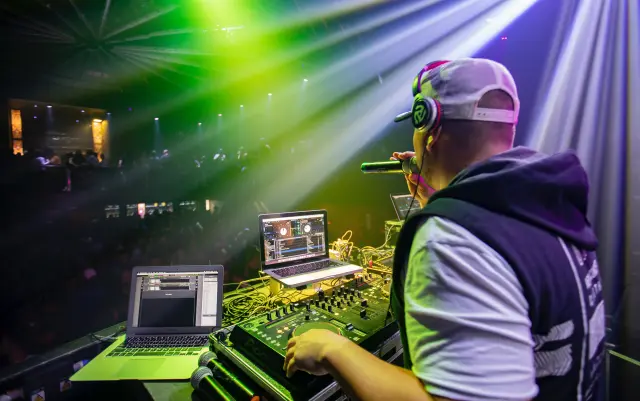
A reliable music-sync setup usually combines fixtures, control hardware, signal structure, and scene logic.
- a DMX controller or lighting console that can run scenes and transitions
- fixtures that support responsive movement, dimming, color, and effect control
- clear fixture grouping by role, such as movement, wash, booth, and accent layers
- music input logic, BPM logic, or operator-driven scene timing
- stable signal flow across the full lighting system
In many nightlife venues, the most effective music-sync systems are built around dj moving head lights for movement, supported by dj led lights for atmosphere and room continuity.
How Should Fixtures Be Grouped for Music Sync?
Fixtures should be grouped by musical function, not only by where they are installed.
If all fixtures are treated as one group, the lighting system often feels flat because every effect happens at the same time. A better strategy is to divide fixtures into layers that can react differently to music.
- movement layer for beam sweeps, tilt movement, and energy changes
- wash layer for room color and atmosphere
- booth layer for performer focus and identity
- accent layer for strobes, bursts, and effect peaks
With this kind of structure, the room can respond to music more intelligently. A drop may activate movement and accent layers strongly, while the wash layer changes more gradually. A breakdown may reduce movement while keeping booth identity visible. This creates a much more intentional nightclub experience.
| Fixture Group | Music-Sync Role | Main Benefit |
|---|---|---|
| Movement Group | responds to drops and rhythmic motion | creates energy and direction |
| Wash Group | supports mood and transitions | keeps room visually connected |
| Booth Group | holds DJ focus during scenes | maintains performance center |
| Accent Group | supports high-impact moments | adds contrast and intensity |
What Is the Difference Between Sound-Activated and Programmed Music Sync?
Sound-activated lighting reacts automatically to audio input, while programmed music sync uses a more structured scene-based approach.
Sound-activated modes can be useful in smaller venues, basic rentals, or simple temporary setups. They are fast to deploy and require little programming. However, they are often less controlled and can feel repetitive or overly reactive. Programmed music sync, by contrast, allows the system to follow musical structure more intelligently and gives the operator better control over scene intensity and visual flow.
- sound-activated systems are faster to deploy
- programmed systems usually create more premium results
- sound-reactive modes are useful in lower-complexity installations
- scene-based sync is better for serious nightclub branding and performance consistency
If you want a simpler automatic approach, it helps to understand how sound activated systems behave compared with fully programmed DMX-based control.
How Should Music Sync Be Designed for Different Venue Types?
Different venues need different sync strategies because the audience experience and room structure vary.
Small clubs usually benefit from simpler sync logic with clear beam movement and limited but strong accent moments. Overprogramming a small room often makes it feel visually messy.
Medium venues can support more layered sync logic, where wash, movement, and booth layers respond differently to musical sections. These venues often benefit the most from structured scene programming.
Larger clubs and dance venues usually need zone-based sync logic, where the dance floor, booth, and perimeter work together but do not all peak at the same time.
Some systems also combine nightclub operation with softer event modes, so the same setup may need to support more restrained scenes similar to wedding banquet lighting outside of peak nightlife use.
What Fixture Types Respond Best to Music?
Not every fixture type should react to music in the same way. The strongest systems match fixture behavior to fixture purpose.
Moving beams usually respond best to drops, rhythmic sweeps, and directional movement patterns. Wash fixtures usually work better with slower transitions, color changes, and room-building scenes. Strobes and matrix effects should be used more selectively so they maintain impact. Laser fixtures can be highly effective in musical peaks when the venue has appropriate haze and ceiling depth.
- beam fixtures respond well to intensity and directional timing
- wash fixtures respond well to mood and transition timing
- strobe fixtures work best as controlled accents
- laser fixtures add strong peak energy when used with restraint
Many venues use combinations including strobe light and dj laser lights as part of controlled music-sync peaks rather than constant operation.
What Are the Most Common Music-Sync Mistakes?
Most mistakes happen when operators try to make every fixture react to every beat all night.
- running maximum movement continuously
- using strobe effects too often so they lose impact
- allowing the booth to disappear during heavy room scenes
- using sound activation with no layer separation
- building scenes around fixture tricks instead of musical structure
In many real clubs, the best improvement comes not from adding fixtures but from reducing chaos and improving timing logic.
Real Project Example: Improving Music Sync in a Club
In one medium-sized nightclub, the original music-sync setup relied on automatic sound activation across almost all fixtures. The result was energetic for a few songs but felt repetitive and uncontrolled over time. After reorganizing the system into movement, wash, booth, and accent groups, the venue rebuilt its scenes around musical sections rather than raw beat response. The booth remained visible, drops felt stronger, and the room became more immersive without changing the hardware.
What Should Professional Buyers Check Before Approving a Music-Sync System?
Before approving a music-sync lighting setup, professional buyers should verify:
- whether the controller supports the venue’s required complexity
- whether fixtures are grouped by visual role
- whether the system can handle both low-energy and peak-energy scenes
- whether booth visibility is preserved during intense effects
- whether maintenance, signal flow, and future expansion have been considered
Music Sync DJ Lighting – FAQs
What is the best way to sync DJ lights with music in a club?
The best way is usually to combine clear DMX grouping, structured scene programming, and music-responsive timing rather than relying only on simple beat-triggered automation.
Are sound-activated lighting modes good enough for professional club use?
They can work for simpler venues, but programmed scene-based systems usually create stronger, more controlled, and more premium nightlife results.
What fixtures respond best to music sync in nightclub systems?
Moving beam fixtures usually respond best to drops and directional motion, while wash fixtures work better for atmosphere and transitions, with strobes and lasers used selectively for peak moments.
What should professional buyers check before choosing a music-sync lighting setup?
They should check controller capability, fixture grouping logic, booth visibility strategy, effect contrast, and whether the system can maintain quality over long operating hours.
In conclusion, syncing DJ lights with music in club lighting setup requires more than letting fixtures react to audio. The strongest results come from structured control, fixture grouping, musical contrast, and scene logic that matches the actual room and audience experience.
For automatic response systems and simpler reactive setups, refer to sound activated.


Leave a Reply