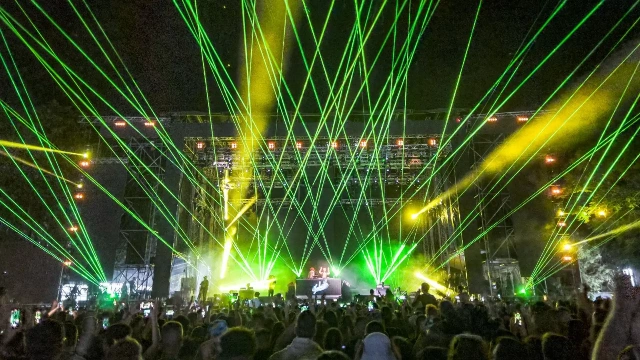
Laser stage lighting is used in professional systems to deliver high-precision beams, aerial effects, and programmable graphics across large-scale venues. In B2B environments such as concerts, nightclubs, and touring productions, laser fixtures must integrate with control systems, power distribution, and safety frameworks.Unlike conventional fixtures, laser systems require careful configuration of scanning speed, beam divergence, and control protocols. Improper integration can result in unstable projection, signal delay, or safety risks, especially in high-density lighting systems.This guide explains how to use laser stage lighting in professional systems, focusing on real-world setup logic, procurement decisions, and system-level performance.
How Does Laser Stage Lighting Work in Professional Systems?
Laser stage lighting works by projecting coherent beams controlled through scanning systems and digital interfaces.
Core Technical Characteristics
- Beam divergence: typically <2 mrad for long-distance projection
- Scanning speed: 20–40kpps affects smoothness
- Output power: 1W–10W+ depending on application
Control Systems (DMX vs ILDA)
| Protocol | Best Use | Limitation |
|---|
| DMX | Basic beam effects | Limited projection precision |
| ILDA | Graphics and animation | Higher setup complexity |
In large-scale concert systems, using only DMX for laser control often results in limited projection accuracy, especially when graphics or logos are required.

What Is the Standard Laser Lighting System Structure?
A professional laser lighting system follows a structured signal and power architecture.
- Controller → DMX/ILDA interface → laser fixtures
- Signal splitter → multi-fixture distribution
- Power distribution → voltage stability
- Safety system → emergency stop and scan protection
This structure is widely used in
night club lights environments where synchronization and safety are critical.
Laser lighting must be configured systematically to ensure stable operation.
- Assign DMX addresses or ILDA channels correctly
- Match channel modes across fixtures
- Set scanning zones and projection angles
- Test synchronization with other lighting devices
| Parameter | Recommended Range | Impact |
|---|
| Scanning Speed | 25–35kpps | Image smoothness |
| Power Output | 3W–8W | Visibility range |
| Projection Distance | 10–50m | Coverage |
How to Choose the Right Laser Lighting System for Your Project?
The correct laser system depends on venue size and application requirements.
- Small venue: 1–3W laser, DMX control
- Nightclub: 3–6W RGB laser, DMX + ILDA
- Concert stage: 6W+ laser, ILDA required
Stage Lighting Setup by Scenario
Laser lighting configuration varies depending on the event environment.
Nightclub and Entertainment Venues
Focus on synchronized beam effects and fast scanning response.
Concert and Touring Systems
Require high output power and long-distance projection stability.
Outdoor Events
Require weather protection, strong beam visibility, and stable mounting systems.
Real-World Setup Issues in Professional Projects
In real projects, laser systems often fail due to integration and environmental factors.
- Signal delay when more than 25 fixtures share one DMX chain
- Laser overheating in outdoor environments without proper cooling
- Beam misalignment due to incorrect mounting angles
- Inconsistent output caused by mixed firmware versions
Laser Stage Lighting Procurement Checklist
A structured checklist helps reduce risk in bulk purchasing and system deployment.
- Confirm laser class and safety certification
- Verify scanning speed and beam consistency
- Check DMX and ILDA compatibility
- Evaluate thermal management system
Professional Trust and Industry Insight
In real-world stage lighting projects, system stability and compatibility are often prioritized over peak specifications. Professional laser systems require precise integration, safety compliance, and consistent long-term performance.Laser Stage Lighting – FAQs
What laser power is suitable for large venues?
For large venues, 5W–10W systems are typically required to maintain visibility over long distances.When should ILDA be used instead of DMX?
ILDA is required for precise graphics and animation, while DMX is suitable for basic effects.What causes instability in laser systems?
Common causes include signal overload, poor cooling, and incorrect configuration.How to ensure consistency in bulk laser purchases?
Check batch testing reports, firmware versions, and beam uniformity across units.In summary, using laser stage lighting in professional systems requires structured configuration, correct protocol selection, and real-world validation. Proper integration ensures stable performance across complex lighting environments.For full system setup, refer to
how to set up stage lighting for bands and live events.