
Church Stage Lighting Equipment Guide for Professional Setup
Building a professional church lighting setup is not about purchasing random fixtures — it is about selecting the right equipment structure that works reliably for worship services, live streaming, volunteer operation, and future expansion.
Many churches spend significant budgets on equipment but still struggle with poor lighting coverage, unstable control systems, inconsistent live streaming quality, or systems that quickly become outdated. In most cases, the problem comes from buying equipment without understanding how the full lighting system should function together.
If you are planning a church stage lighting systems project, this guide explains the essential lighting equipment needed for professional worship production and how to avoid the most common purchasing mistakes.
What “Professional Church Lighting Equipment” Actually Means
Professional lighting equipment is not defined by having more fixtures. A professional system is one that delivers:
- Reliable weekly operation
- Balanced lighting quality
- Stable control and DMX communication
- Streaming-friendly visuals
- Simple workflows for volunteers
Common mistake: focusing on effect fixtures before building the core lighting structure.
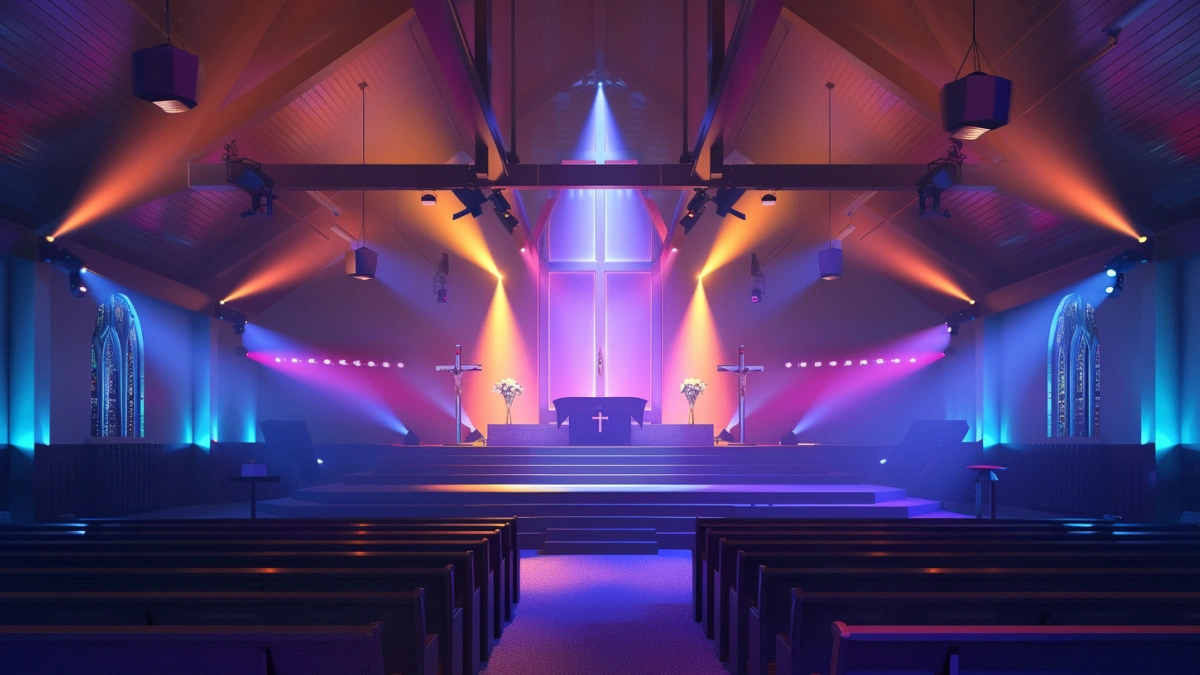
The 7 Core Equipment Categories Every Church Needs
1. Front Lighting Equipment (Highest Priority)
Front lighting is the foundation of all church stage lighting systems because it controls visibility.
Main purpose:
- Illuminate speakers clearly
- Improve camera exposure
- Reduce harsh shadows
Professional setup tips:
- Install fixtures at 30°–45° angles
- Balance left and right brightness evenly
- Avoid direct overhead-only lighting
Without proper front lighting, no other equipment can compensate for poor stage visibility.
2. Wash Lighting Equipment (Coverage Layer)
Wash lighting provides even stage illumination and supports atmosphere creation.
Fixtures such as wash moving head are widely used because they combine:
- Wide beam coverage
- Flexible color control
- Smooth dimming capability
Most common issue: uneven wash distribution creating bright and dark areas on stage.
Solution: overlap beam coverage for smoother output.
3. Background Lighting Equipment (Depth Layer)
One of the biggest differences between amateur and professional church lighting setups is depth lighting.
Background fixtures help:
- Create visual separation
- Improve live streaming image quality
- Enhance stage atmosphere
Recommended equipment:
- Wall wash fixtures
- LED bars
- Soft background color fixtures
4. Atmosphere and Effect Equipment
Modern worship environments often use controlled atmosphere lighting during music segments.
Fixtures such as concert moving head light are commonly used for:
- Beam effects
- Slow movement transitions
- Visual texture during worship
Important: atmosphere lighting should support worship emotionally without distracting the congregation.
5. Lighting Control Systems
The lighting controller is the brain of the entire system.
A good control system should:
- Support expandable DMX universes
- Allow simple preset programming
- Remain easy for volunteers to operate
Common mistake: choosing complex consoles that volunteers cannot manage efficiently.
6. DMX Distribution Equipment
DMX infrastructure is often ignored until problems occur.
Essential equipment includes:
- DMX splitters
- Signal boosters
- Reliable DMX cabling
Common problems:
- Signal loss
- Fixture communication failures
- Intermittent lighting response
Professional signal distribution prevents these issues.
7. Rigging and Mounting Equipment
Lighting installation safety is critical in church environments.
Important equipment:
- Truss systems
- Mounting clamps
- Safety cables
- Power distribution systems
Poor rigging creates both safety risks and inconsistent fixture positioning.
Recommended Equipment Structure by Church Size
Small Church Equipment Setup
- 4–6 wash fixtures
- 2–4 front fixtures
- Basic DMX controller
- Simple background lighting
Focus: affordable and volunteer-friendly operation
Medium Church Equipment Setup
- 8–12 wash fixtures
- 4–6 front fixtures
- 2–4 atmosphere fixtures
- Expandable control system
Focus: balanced worship production and live streaming
Large Church Equipment Setup
- 12–20 wash fixtures
- 6–10 front fixtures
- Advanced atmosphere systems
- Multiple DMX universes
Focus: immersive worship production and scalable infrastructure
The Biggest Church Equipment Purchasing Mistakes
1. Buying Effect Lights First
Result: visually impressive effects but poor visibility
Correct approach: prioritize front and wash lighting first
2. Ignoring Streaming Compatibility
Result: flickering or poor camera exposure
Correct approach: choose flicker-free fixtures with stable dimming
3. Underestimating Control Systems
Result: difficult operation and inconsistent weekly services
Correct approach: invest in scalable but simple control systems
4. Poor Infrastructure Planning
Result: cable issues and unreliable signal distribution
Correct approach: design DMX and power infrastructure early
How Professional Churches Plan Equipment Upgrades
Successful churches rarely buy everything at once.
Professional upgrade strategy:
- Improve front visibility lighting
- Add wash coverage
- Upgrade background lighting
- Add atmosphere fixtures gradually
- Expand control and DMX infrastructure
This phased approach avoids wasted budget and inconsistent systems.
How Equipment Impacts Worship Experience
Lighting equipment directly affects how worship environments feel emotionally and visually.
Balanced lighting systems create:
- Clear visual focus
- Better audience engagement
- Higher streaming quality
- More immersive worship environments
Good lighting equipment supports worship instead of distracting from it.
👉 Build a Church Lighting Equipment System That Lasts
The best equipment setup is not the one with the most fixtures — it is the one that delivers stable, repeatable performance every week.
Focus on:
- Front visibility first
- Balanced wash coverage
- Reliable DMX infrastructure
- Streaming-friendly fixture selection
- Simple volunteer operation
If you are planning complete bundled solutions for worship spaces and events, this guide explains the next stage in detail: lighting packages .
FAQs
What equipment is needed for church stage lighting?
Front lights, wash lights, control systems, and DMX infrastructure are essential.
What is the most important lighting equipment?
Front key lighting for visibility and cameras.
Why do churches need DMX systems?
DMX controls and synchronizes lighting fixtures.
Should churches use moving head fixtures?
Yes, for atmosphere and worship production when used carefully.
What causes uneven stage lighting?
Poor fixture spacing and weak wash coverage.
What is the biggest equipment mistake?
Buying effect fixtures before solving core lighting needs.