
DMX Lighting Control Systems for Concert and Stage Production
DMX lighting control systems are the core infrastructure behind modern concert and stage production. While basic DMX setups can control a limited number of fixtures, large-scale productions require advanced systems capable of managing hundreds of devices across multiple universes with precision and reliability.
For professional buyers, understanding how a lighting control console integrates into advanced DMX systems is critical when designing scalable and future-proof lighting solutions. A properly designed system ensures stable performance, efficient control, and seamless expansion as production requirements grow.
What Defines an Advanced DMX Lighting Control System
An advanced DMX lighting system goes far beyond simple console-to-fixture connections. It includes structured signal distribution, multi-universe management, network integration, and redundancy design. These elements work together to support large-scale productions where reliability and scalability are essential.
In professional environments, DMX is often combined with network protocols such as Art-Net and sACN. These technologies allow multiple DMX universes to be transmitted over Ethernet networks, enabling the control of hundreds or even thousands of lighting parameters simultaneously.
This hybrid architecture is now standard in concerts, touring productions, and large events, where traditional DMX cabling alone cannot meet system requirements.
Advanced DMX System Architecture for Concert Production
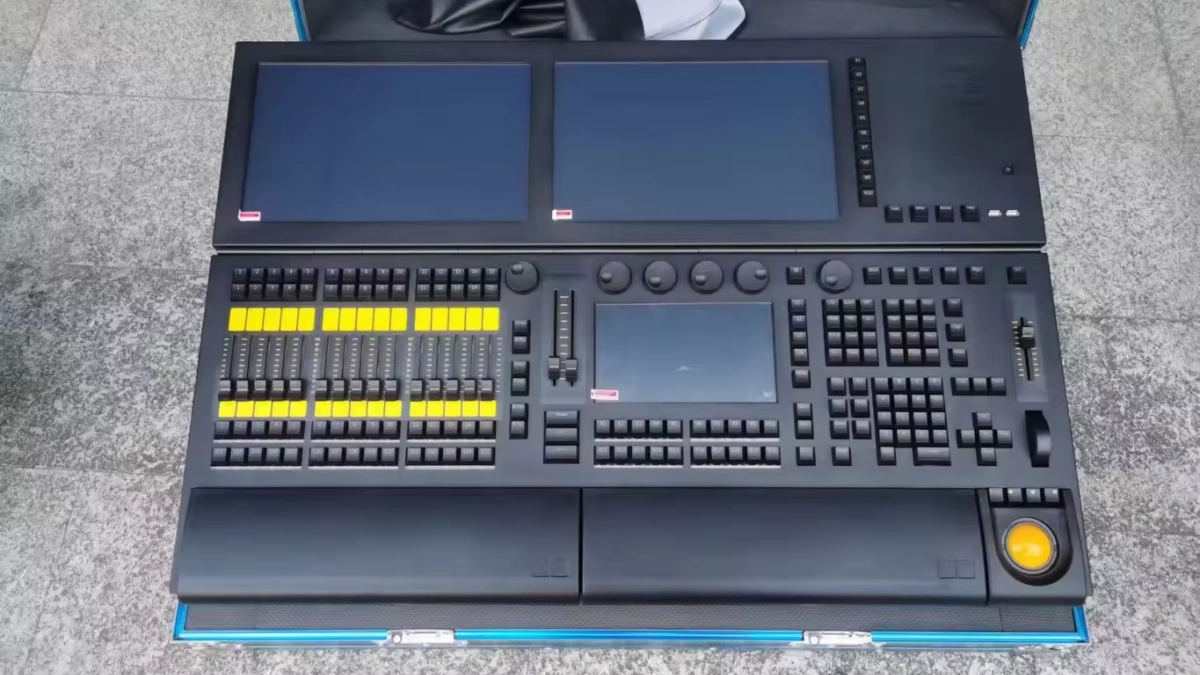
In large-scale concert productions, the DMX control system follows a layered architecture. The system begins with a central console, which generates control data. This data is transmitted over Ethernet networks using Art-Net or sACN protocols.
Network nodes are used to convert Ethernet signals into DMX outputs. These outputs are then distributed through DMX splitters, ensuring stable signal delivery across multiple fixture lines.
The complete system structure can be defined as:
Console → Network Switch → Art-Net Node → DMX Splitter → Fixtures
This architecture allows for flexible system design, enabling fixtures to be distributed across large stages and multiple truss structures without signal degradation.
Multi-Universe DMX Control and Channel Planning
Each DMX universe provides 512 channels, which are used to control fixture parameters. In advanced systems, multiple universes are combined to handle large numbers of fixtures.
Channel planning is a critical step in system design. For example, a concert moving head light may require 25 channels, while a wash moving head fixture may use 15–20 channels.
In a system with 100 fixtures, total channel usage can easily exceed 2000 channels, requiring at least 4–6 DMX universes. Larger productions may require 10–20 universes to accommodate complex lighting designs.
Efficient channel allocation ensures that fixtures are organized logically, reducing the risk of addressing conflicts and improving system performance.
Example Advanced DMX Lighting System Setup
To illustrate how these systems are implemented in real projects, consider a large concert production with 200 fixtures. The system may include:
- 1 main lighting console + 1 backup console
- 8–16 DMX universes
- 6–10 Art-Net nodes
- Multiple DMX splitters and network switches
The fixture setup may include 80 beam fixtures for dynamic effects, 60 wash fixtures for stage coverage, and 20 concert strobe light systems for high-impact moments.
Additional visual layers can be added using concert laser light systems, which extend lighting effects into the audience space.
This type of system demonstrates how advanced DMX control enables large-scale productions to achieve high levels of visual complexity and synchronization.
Redundancy and System Reliability in Large Productions
Reliability is a critical factor in professional lighting systems. Any failure in the control system can disrupt the entire production. To address this, redundancy is built into advanced DMX systems.
Redundant consoles are often used, allowing a backup system to take over in case of failure. Network redundancy is also implemented using multiple switches and data paths, ensuring continuous communication.
Power redundancy is another important consideration, with backup power systems used to prevent interruptions during live events.
Common Challenges in Advanced DMX Systems
One of the main challenges is managing system complexity. As the number of fixtures increases, addressing, channel allocation, and programming become more difficult.
Network configuration is another critical area. Poor network design can lead to latency or data loss, affecting system performance. Using professional-grade network equipment and proper configuration is essential.
Signal distribution must also be carefully planned to avoid degradation. DMX splitters and signal boosters help maintain signal quality across large systems.
What Professional Buyers Should Consider
When selecting advanced DMX lighting systems, professional buyers should focus on scalability, reliability, and integration capabilities. The system must be able to support current production requirements while allowing for future expansion.
Compatibility with network protocols is essential for large-scale systems. Consoles that support Art-Net and sACN provide greater flexibility and scalability.
Ease of setup and operation should also be considered. Systems that simplify configuration and programming can significantly improve efficiency.
Finally, buyers should evaluate support and training options, as these can have a major impact on long-term system performance.
FAQs
What is the difference between DMX and Art-Net?
DMX is a direct control protocol, while Art-Net transmits DMX data over Ethernet networks.
How many universes are needed for large concerts?
Large productions typically require 8–20 universes depending on fixture count.
Why is redundancy important in lighting systems?
It ensures uninterrupted operation during live events.
What is the biggest challenge in DMX systems?
Managing complexity and ensuring reliable signal distribution.
For system control workflow, see DMX control.