
How to Use Concert Laser Lights in Stage Show Design
Using concert laser lights in stage show design requires more than placing projectors around the stage and triggering them during loud musical moments. In professional concert production, laser lighting works best when it is integrated into the visual architecture of the show. It should support stage geometry, reinforce musical structure, and strengthen the audience’s sense of space and immersion. When used correctly, laser lighting can elevate a stage design from functional to unforgettable. When used poorly, it can feel repetitive, distracting, or visually disconnected from the rest of the production.
For professional buyers such as stage designers, show directors, concert planners, and live event contractors, the question is not simply whether to add lasers. The real question is how to use concert laser lights in a way that improves the total production. That means thinking about timing, sightlines, stage depth, performer focus, surrounding fixture layers, and how the laser moments support the emotional structure of the show.
This guide explains how to use concert laser lights in stage show design, how lasers interact with stage architecture, what design patterns work best in live productions, and what professional buyers should review before adding laser-driven visuals into a major concert system.
Why Laser Lights Matter in Stage Show Design
Laser lights matter because they create a kind of visual geometry that traditional fixtures do not produce in the same way.
Where moving heads create motion and wash fixtures create atmosphere, lasers create graphic structure. They can define invisible space, draw audience attention across large volumes, and transform a simple stage into a much more immersive environment. They are especially effective in moments when the show needs to feel larger, sharper, or more futuristic.
- they create strong spatial definition
- they extend visual energy beyond the physical stage
- they add modern, high-precision show language
- they support music peaks and major transitions with strong visual contrast
This is why many production teams include laser scenes inside a broader concert laser light strategy rather than treating lasers as a separate visual add-on.
How Should Concert Laser Lights Fit into Overall Stage Design?
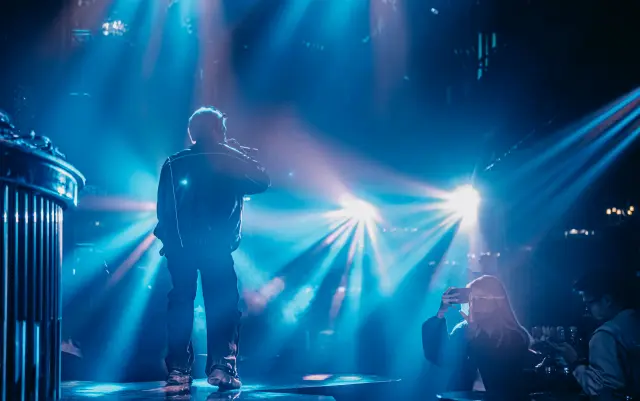
Concert lasers should support the full stage composition, not sit on top of it without purpose.
A stage show usually includes multiple visual layers: performer focus, scenic background, movement beams, wash atmosphere, and accent effects. Laser lights should be integrated into this structure in a way that strengthens the existing design. They are most effective when they reinforce the stage architecture, align with the music, and appear at the right times.
- use lasers to emphasize stage width or depth
- align laser direction with the visual perspective of the stage
- preserve performer readability when laser scenes are active
- ensure the laser layer supports rather than competes with movement and wash layers
In many live productions, this kind of integration works best when the larger rig is still built around categories such as concert moving head light and wash fixtures that provide continuity between laser moments.
What Stage Show Moments Work Best for Laser Lighting?
Laser lighting works best in moments where the show needs a strong visual shift or a dramatic sense of expansion.
Typical high-value moments include:
- opening intros where anticipation is building
- big drops or chorus peaks where the room needs to explode visually
- transitions between songs where the stage identity changes
- electronic or cinematic sections where spatial atmosphere matters more
- finale scenes where the full visual system should feel maximal
Lasers can also work well in slower sections if the design is minimal and intentional, but they usually create the most value when paired with strong musical contrast.
| Show Moment | Laser Use Strategy | Main Result |
|---|---|---|
| Intro | controlled geometric build | anticipation and focus |
| Drop | wide atmospheric burst | maximum scale and energy |
| Transition | directional change and pattern shift | clear visual reset |
| Finale | full-stage integration | memorable climax |
How Should Lasers Be Balanced with Other Concert Fixtures?
Lasers should be balanced with beam, wash, and accent layers so that the stage remains readable and emotionally varied.
If lasers are too dominant, the stage can lose performer clarity and visual depth. If they are too weak, they may not justify their presence in the design. The best balance usually comes when:
- beam layers create motion around laser geometry
- wash layers preserve stage mood and depth
- accent fixtures such as strobes increase contrast carefully
- performer visibility remains protected in key narrative moments
For stronger impact scenes, some productions combine lasers with concert strobe light accents, but this should be used selectively so that both layers retain value.
What Are the Most Effective Laser Design Approaches?
The most effective approaches usually focus on clarity, contrast, and spatial intention.
Some shows use lasers to frame the stage. Others use them to extend the audience space. Some productions use strong symmetrical laser architecture, while others use asymmetry to create tension and movement. The important factor is not the style itself, but whether the style matches the music and stage design.
- symmetrical laser fans create strong stage authority
- audience-directed patterns create immersion
- rear-stage laser geometry adds depth behind performers
- minimal laser scenes can be very effective before larger visual peaks
Strong design usually comes from choosing one clear role for the laser layer in each section rather than trying to use every possible effect at once.
What Are the Most Common Laser Design Mistakes?
Most mistakes come from overuse or poor integration.
- using laser scenes too often so they lose emotional value
- failing to align laser timing with musical structure
- making lasers visually stronger than the performers at the wrong moments
- treating lasers like decoration rather than visual architecture
- ignoring how haze conditions affect real visibility
One of the most common problems is a stage show where the laser layer feels disconnected from the movement and wash logic. The individual laser moments may look impressive, but the overall show feels inconsistent.
Real Project Example: Improving Laser Use in Stage Design
In one large live production, the initial laser plan placed heavy laser content in almost every song. During rehearsals, the system looked strong at first, but the effect quickly became repetitive and started to reduce the impact of the show’s major peaks. The design was revised so that lasers were concentrated in show intro, selected drops, and the finale. The rest of the production relied more on movement and wash development. This created stronger contrast, and the audience response improved because the laser moments regained real value.
What Should Professional Buyers Check Before Approving Laser Use in Stage Design?
Before approving laser integration into a stage show, professional buyers should verify:
- whether the stage format and music style actually benefit from laser scenes
- whether the laser layer is integrated with movement and wash design
- whether performer visibility remains protected
- whether the timing logic preserves contrast over the full show
- whether the laser moments create real design value rather than simple novelty
In some multi-use stage environments, the venue may also need softer visual modes closer to wedding and event lighting when the stage is not operating in full concert mode, which makes contrast planning even more important.
Concert Laser Lights in Stage Design – FAQs
How should concert laser lights be used in stage show design?
They should be used as a structured visual layer that supports stage geometry, musical timing, and audience immersion instead of running constantly without contrast.
What is the biggest mistake when using concert lasers in stage design?
The biggest mistake is overusing laser scenes or failing to integrate them with the wider movement, wash, and performer-focus structure of the show.
Do lasers work best in every song of a live production?
No. Lasers are usually most effective when reserved for intros, drops, major transitions, and finale moments where they add clear visual contrast and scale.
What should professional buyers review before approving laser-based stage design?
They should review timing logic, performer visibility, integration with the wider lighting rig, stage suitability, and whether the laser layer adds real value to the full production.
In conclusion, using concert laser lights in stage show design is most effective when the laser layer is integrated, selective, and aligned with the architecture of the full show. The strongest laser scenes are the ones that amplify the production’s visual storytelling rather than overwhelm it.
For full-system structure and projector-layer strategy, refer to laser lighting systems.