
Event Lighting Setup for Concerts and Live Performances
Event lighting setup for concerts and live performances requires a structured approach that combines technical precision, system scalability, and visual creativity. Unlike small event setups, concert lighting systems must deliver high output, synchronized effects, and reliable performance across large venues.
For B2B buyers such as production companies, rental providers, and system integrators, building a proper event lighting setup is not just about selecting fixtures. It involves designing a complete lighting system that integrates fixture types, control systems, signal distribution, and power management.
This guide explains how to design and implement event lighting setup for concerts and live performances using real-world engineering logic and scalable configuration strategies.
What Defines a Professional Concert Event Lighting Setup?
A professional concert lighting setup is defined by its ability to deliver high-impact visuals while maintaining system stability.
- High-output fixtures for large coverage
- Layered lighting design for depth
- Reliable DMX control system
- Balanced power distribution
These systems are commonly used in event lighting for weddings and large production environments.
What Equipment Is Required for Concert Lighting Setup?
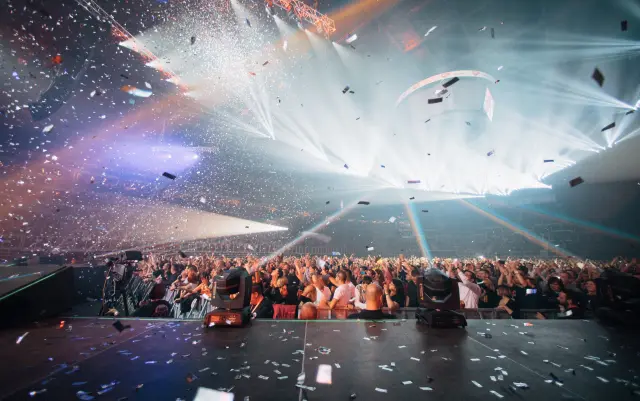
A concert lighting system includes multiple fixture types working together.
- Beam lights – for long-distance effects and movement
- Wash lights – for stage coverage and ambient lighting
- Profile lights – for precise focus on performers
- Effect lights – for visual enhancement
Understanding these systems is essential for building effective concert event lighting.
How to Set Up Event Lighting for Concerts Step by Step?
Concert lighting setup requires careful planning and structured execution.
1. Plan the Lighting Layout
- Define stage dimensions and rigging positions
- Ensure full coverage across performance areas
2. Configure Fixture Placement
- Front lighting for visibility
- Back lighting for depth
- Side lighting for movement
3. Design DMX Control System
- Segment fixtures into DMX universes
- Use splitters for large systems
4. Balance Power Distribution
- Distribute load across circuits
- Prevent overload risks
| Setup Area | Correct Approach | Common Mistake |
|---|---|---|
| Layout | Full coverage | Uneven lighting |
| Control | Structured DMX | Signal overload |
| Power | Balanced load | System failure |
What Equipment Configuration Works for Different Concert Sizes?
Lighting setup varies depending on venue size.
| Concert Size | Recommended Setup |
|---|---|
| Small Concert | 6–10 wash lights + minimal effects |
| Medium Concert | 8–16 beam + 8–12 wash lights |
| Large Concert | Full system including beam, wash, profile, effects |
Many systems are designed around event hall lighting applications.
Why Do Concert Lighting Systems Fail?
Most failures occur due to poor system design rather than equipment quality.
- Too many fixtures on one DMX line
- Improper fixture positioning
- Unbalanced power distribution
- Lack of system testing
In large concerts, signal delay becomes critical when DMX distribution is not properly planned.
Real Project Example: Concert Lighting Optimization
In a live concert, overloaded DMX chains caused delayed lighting response. After restructuring the system with splitters, performance improved significantly.
What Should Buyers Consider for Concert Lighting Systems?
B2B buyers should focus on scalability and reliability.
- System compatibility
- Fixture consistency
- Ease of installation
- Supplier reliability
Concert Event Lighting – FAQs
What lighting is best for concerts?
A combination of beam, wash, and profile lighting is recommended.
How to avoid signal delay in concert lighting?
Use DMX splitters and distribute fixtures across multiple universes.
What is the biggest mistake in concert lighting setup?
Overloading DMX lines and improper fixture placement.
How to ensure stable lighting performance?
Use structured system design and perform full testing before events.
In conclusion, event lighting setup for concerts requires structured design, proper configuration, and real-world testing.
For live production strategies, refer to stage lighting for live shows.