
How to Choose Concert Stage Lights for Touring Projects
Choosing concert stage lights for touring projects requires a very different decision process from choosing fixtures for fixed venue installations. Touring systems must perform consistently across changing venues, survive transport stress, fit into strict loading schedules, and still deliver a strong visual show every night. A touring lighting rig that looks powerful on paper can quickly become inefficient if it is too heavy, too inconsistent in fixture types, or too difficult to service on the road.
For professional buyers such as touring production managers, rental companies, stage contractors, and event lighting planners, the goal is not only to buy strong fixtures. The goal is to choose concert stage lights that balance performance, portability, standardization, and programming efficiency. Touring success depends on how well the system can adapt to different truss heights, stage widths, truck space limits, and show formats without losing visual quality.
This guide explains how to choose concert stage lights for touring projects, including how to evaluate fixture categories, how to balance power with transport practicality, and what professional buyers should verify before committing to a touring lighting package.
What Makes Touring Lighting Different from Fixed Concert Lighting?
Touring lighting must be strong enough for professional concerts while remaining practical enough to move from venue to venue.
In a fixed installation, fixtures can be optimized for one room and remain in position for long periods. Touring rigs do not have that luxury. The system must be packed, loaded, unloaded, hung, focused, programmed, and maintained repeatedly. That means touring fixtures must be chosen not only for output but also for size, weight, reliability, and compatibility.
- fixtures must be transport-friendly
- rigs must scale across different stage sizes
- fixture families should be standardized where possible
- control logic should remain repeatable across venues
This is why production teams often begin with a full concert stage lighting concept before deciding on the exact touring fixture mix.
What Fixture Types Usually Work Best for Touring Projects?
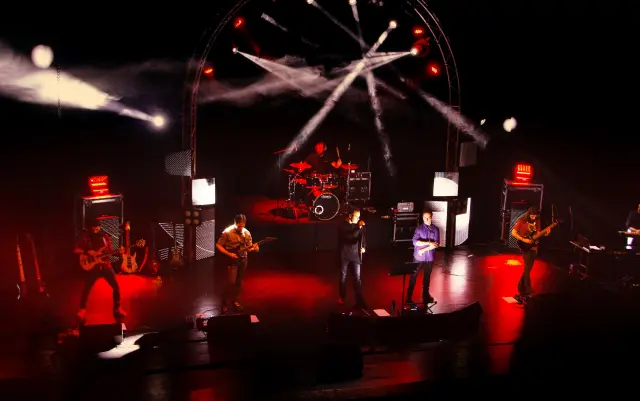
Most touring systems use a balanced mix of fixture categories rather than relying on one type alone.
- beam moving heads for aerial motion and large-scale energy
- wash moving heads for scenic coverage and room continuity
- profile fixtures for key performer visibility and precision
- effect fixtures for accent moments and transitions
Many touring productions rely on moving head lights as the core movement layer, while using led wash moving head fixtures to stabilize the visual environment across different venues.
How Should Professional Buyers Balance Output and Portability?
The best touring fixtures are not always the biggest or most powerful. They are the ones that deliver the right performance for the show while remaining practical to move, install, and maintain.
Professional buyers should compare:
- output versus fixture size and weight
- beam strength versus real venue throw requirements
- road-case efficiency and truck loading practicality
- cooling reliability under repeated operation
- serviceability on tour
In many touring projects, a slightly smaller but more efficient fixture becomes more valuable than a heavier fixture that complicates transport and rigging.
| Selection Factor | Why It Matters on Tour | Typical Risk if Ignored |
|---|---|---|
| Weight | affects trucking and rigging speed | slower load-ins |
| Output | must match venue scale | weak show visuals |
| Standardization | simplifies programming and spares | maintenance complexity |
| Durability | supports repeated transport | higher failure rates |
Why Is Fixture Standardization Important in Touring Projects?
Standardization is one of the most valuable strategies in touring production because it reduces programming complexity and service risk.
When a system uses too many different fixture families, programming becomes slower, patching becomes more fragile, and carrying spare parts becomes more expensive. Standardized fixture groups make cue building faster and simplify crew workflows.
- faster DMX patching and troubleshooting
- easier preprogramming and show file reuse
- simpler spare fixture and spare parts management
- more predictable output consistency across the rig
This is one reason larger tours usually repeat the same fixture families across truss sections whenever possible.
How Should Touring Projects Choose Between Beam, Wash, and Profile Lights?
Each touring fixture type should be selected by function, not by trend.
Beam fixtures are valuable for dynamic movement and high-impact arena visuals. Wash fixtures support stage continuity and prevent the show from feeling visually empty between peak effects. Profile fixtures become especially important when the performance requires stronger performer visibility, scenic detailing, or camera-sensitive precision.
- beam fixtures support large movement scenes
- wash fixtures support atmosphere and scenic balance
- profile fixtures support key performer focus
- effect fixtures should enhance rather than dominate the rig
Many tours also use selective support from strobe light systems or other accent fixtures, but these should not replace the core beam-wash-profile structure.
How Important Is Rigging Strategy When Choosing Fixtures?
Rigging strategy matters because the right fixture can still perform badly if it does not fit the touring truss logic.
Fixtures should be chosen with real rig positions in mind. A fixture that is ideal for rear-truss beam sweeps may not be ideal for front performer coverage. Fixture size, yoke movement clearance, road-case dimensions, and truss loading all influence whether a touring rig remains efficient in practice.
- match fixture dimensions to truss density
- leave enough movement clearance between units
- avoid overloading front truss with heavy fixtures
- consider floor package options for flexible scaling
Good touring rig design helps the same fixture family perform consistently across different venues.
What Are the Most Common Mistakes When Choosing Touring Lights?
The most common mistakes usually come from choosing fixtures for visual ambition without enough attention to touring practicality.
- choosing fixtures that are too heavy for efficient road use
- mixing too many incompatible fixture families
- underestimating venue variation across the tour
- ignoring maintenance and spare support needs
- building a rig that cannot scale down cleanly for smaller venues
One common touring problem is a rig that looks excellent in one large venue but becomes inefficient or visually imbalanced in medium-size stops.
Real Project Example: Improving a Touring Fixture Package
In one touring music production, the initial fixture package included too many heavy beam units and several different fixture families. The show looked strong in larger venues, but the setup time was slow and troubleshooting became increasingly difficult. After reducing fixture variety and rebuilding the system around a more standardized beam, wash, and profile structure, the tour became more efficient. The production lost very little visual impact but gained faster load-ins, cleaner programming, and easier maintenance.
What Should Professional Buyers Verify Before Approval?
Before approving concert stage lights for touring projects, professional buyers should verify:
- whether the fixture package matches the size range of the tour
- whether the system is standardized enough for efficient programming
- whether weight and transport factors are realistic
- whether the support plan for spares and service is strong enough
- whether the rig can scale up and down without major redesign
Touring Stage Lights – FAQs
What are the best concert stage lights for touring projects?
The best touring lights are the fixtures that balance output, portability, standardization, and reliability while fitting the real scale of the venues on the tour.
Why is fixture standardization so important on tour?
It improves programming efficiency, simplifies spare part management, reduces maintenance complexity, and makes the system easier to rebuild across different venues.
What is the biggest mistake when choosing touring concert lights?
The biggest mistake is choosing fixtures only for maximum visual power without considering transport, rigging practicality, and scalability across the tour.
What should professional buyers check before purchasing a touring fixture package?
They should check venue fit, weight, standardization, service support, and whether the system can deliver consistent show quality across different touring conditions.
In conclusion, choosing concert stage lights for touring projects requires balancing visual strength with touring efficiency. The best touring systems are built around standardized, scalable fixture packages that perform reliably in real venues, not only in ideal conditions.
For large-scale movement architecture and fixture role planning, refer to moving head lights.