
How Lighting Consoles Control Stage Lighting Systems Using DMX
Lighting consoles control stage lighting systems through DMX protocols, forming the core communication layer between operators and lighting fixtures. In professional productions, this process is not just about sending signals. It involves structured system design, signal distribution, addressing logic, and real-time control workflows.
For professional buyers, understanding how a lighting control console interacts with DMX systems is essential when building scalable and reliable lighting infrastructures for concerts, stage productions, and live events.
How DMX Signal Flow Works in Stage Lighting Systems
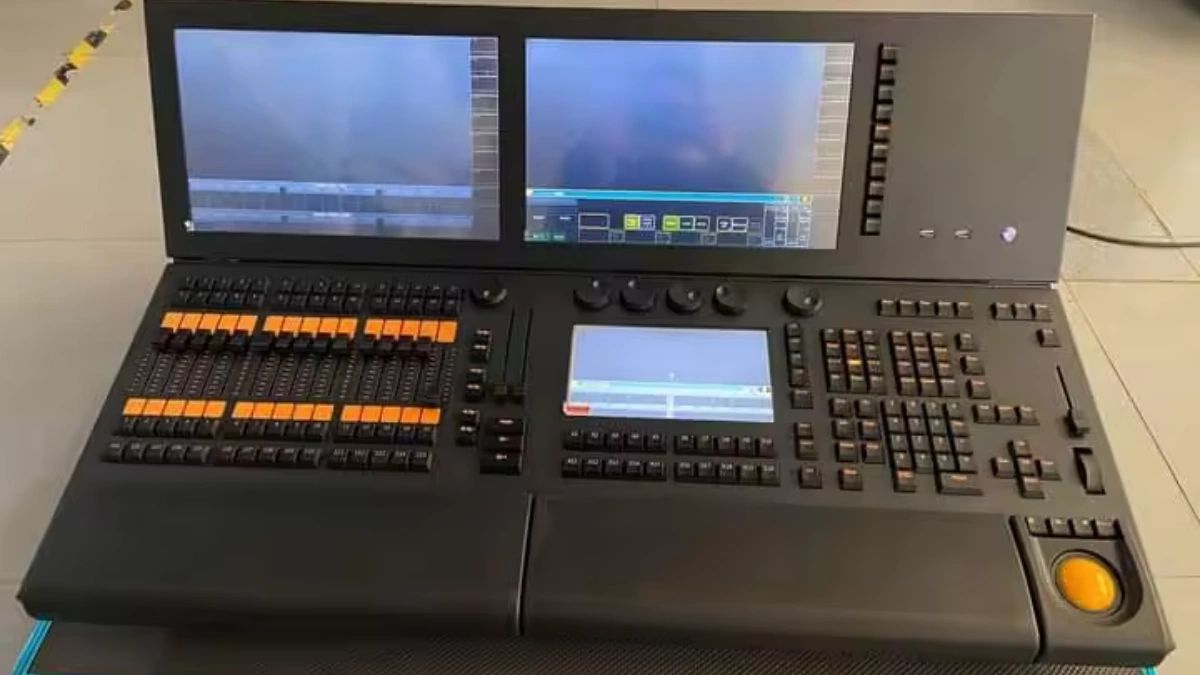
In a professional lighting system, DMX signal flow follows a structured path. The process begins at the lighting console, where control data is generated. This data is transmitted either directly via DMX cables or through network protocols such as Art-Net or sACN.
The signal then passes through network nodes, which convert Ethernet data into DMX outputs. These outputs are distributed using DMX splitters to ensure stable signal transmission across multiple fixture lines.
The full signal path can be summarized as:
Console → Network Node → DMX Splitter → Lighting Fixtures
This architecture ensures that large numbers of fixtures can be controlled reliably without signal degradation.
DMX Addressing and Channel Mapping in Real Systems
Each lighting fixture must be assigned a DMX address, which determines how it receives control signals. Fixtures occupy a specific number of channels depending on their complexity.
For example, a concert moving head light may require 20–30 channels. If it starts at address 1, it will use channels 1–30. The next fixture must start at channel 31 to avoid overlap.
Proper channel mapping is critical in large systems. Incorrect addressing can cause fixtures to behave unpredictably, making system control unreliable.
Understanding DMX Universes in Console Control
A DMX universe consists of 512 channels. Each universe can control a limited number of fixtures depending on their channel usage. In small systems, a single universe may be sufficient. However, larger productions require multiple universes.
For example:
- Small event: 1–2 universes
- Medium stage: 3–6 universes
- Large concert: 8–16+ universes
Modern lighting consoles support multiple universes through network protocols, allowing systems to scale efficiently.
Example DMX Control System for Stage Productions
A typical medium-to-large stage lighting system may include one main console and a backup console for redundancy. The system may control 80–150 fixtures across multiple universes.
The setup may include 48 beam fixtures, 32 wash moving head units, and 16 concert strobe light systems. Additional concert laser light fixtures may be used for large-scale visual effects.
These fixtures are distributed across 6–12 universes, with DMX splitters and network switches ensuring stable communication.
Control Workflow from Programming to Live Execution
Once the system is set up, the lighting console is used to program cues. Each cue defines how lighting behaves at a specific moment in the performance.
Operators organize cues into sequences that match the structure of the show. During live execution, cues are triggered manually or automatically, allowing smooth transitions between lighting states.
Real-time control is also possible, enabling operators to adjust lighting dynamically based on performance changes.
Common Problems in DMX Control Systems and Solutions
One of the most common issues is signal loss, which can occur due to long cable runs or poor-quality connections. Using DMX splitters and high-quality cables helps maintain signal integrity.
Another issue is incorrect addressing, which can cause multiple fixtures to respond simultaneously. Proper planning and testing are essential to avoid this problem.
Network congestion can also affect performance in large systems. Using dedicated network switches and proper configuration ensures stable operation.
What Professional Buyers Should Consider
When selecting DMX lighting control systems, professional buyers should focus on scalability, system compatibility, and reliability. The console must support the required number of universes and integrate with existing equipment.
Ease of setup and operation is also important, especially for large productions where efficiency is critical. Systems that support network protocols provide greater flexibility and future scalability.
Finally, redundancy should be considered to ensure uninterrupted performance during live events.
FAQs
What is the DMX signal path in stage lighting systems?
It follows the structure: console → node → splitter → fixtures.
How many universes are needed for large productions?
Large systems typically require 8–16 or more universes.
What is the most common DMX problem?
Incorrect addressing and signal loss.
How to improve DMX system reliability?
Use proper distribution equipment and network design.
For advanced system architecture, see stage lighting control systems.